To identify a Pokémon card by its number, find the small collector number near the bottom edge, copy every digit and letter, and search for it alongside the Pokémon’s name. Then match the language, set and artwork. The number narrows the search; it does not always identify one unique printing.
For example, Pikachu 025/165 is a more useful starting point than “Pikachu 25.” The slash, leading zero and any letters are worth keeping. Here is how to read them, using four real cards you can compare with your own.
1. Find the right number on the card
Check both bottom corners. On many cards, the collector number sits near the illustrator credit, set symbol or set code. Its position varies with the card’s age and design. You might see a fraction such as 025/165, letters on both sides such as TG05/TG30, or a promo identifier such as 074/DP-P.
Other numbers answer different questions:
- HP and attack damage describe gameplay. They can help confirm a match, but they are not catalog numbers.
- The Pokédex number identifies the Pokémon species. The Pikachu below shows NO. 0025 beneath its illustration; its collector number is 025/165.
- The copyright year is a clue to check alongside the other details, not a unique card identifier.
- A regulation mark, such as the boxed G on that Pikachu, relates to play eligibility. The adjacent MEW expansion code and EN language code are separate markings.
If the text is small, use your phone’s magnifier or a clear close-up. Transcribe what is actually printed before trying shorter searches.
2. Read four common number formats
A regular set number: 025/165

025 is this card’s collector number. 165 is the printed main-set count. This is Pikachu 025/165 from Scarlet & Violet—151.
In the image, Pikachu runs along a branch. At the bottom left, read G · MEW EN · 025/165. Match these details with the card in your hand.
Try searching: Pikachu 025/165
Keep the leading zero. Search tools do not all treat 025/165 and 25/165 as equivalent. In our October 11 check, KnowMyCards found this card with “Pikachu 025/165”; “Pikachu 25/165” returned no results.
A number above the printed set count: 199/165

Charizard ex 199/165 belongs to the same expansion. The left-hand number can exceed the number after the slash because a release can include additional numbered cards beyond its main set.
The official Scarlet & Violet—151 checklist includes Charizard ex at 006, 183 and 199. The name alone would not tell you which illustration you have.
Try searching: Charizard 199/165
A number above the denominator does not, by itself, tell you a card’s value or prove that a physical copy is authentic. It also shows why the printed denominator is not always a count of every card or finish in a release.
If you are comparing several Charizard versions, our illustrated Charizard identification guide walks through different numbers, artwork and stamps.
A lettered subset: TG05/TG30

Pikachu TG05/TG30 is part of the Lost Origin Trainer Gallery. Pokémon describes this gallery as a 30-card subset with its own numbering beginning with TG.
Keep both letter prefixes: TG05/TG30 is the useful identifier, not just “05.” The set symbol and illustration help distinguish it from entries in other Trainer Galleries.
Try searching: Pikachu TG05/TG30
Searching only “TG05/TG30” in KnowMyCards returned Pikachu, Gardevoir and Zekrom entries when we checked. Reused numbering is a reason to add the name and check the set, rather than choose the first result.
A Japanese promo code: 074/DP-P
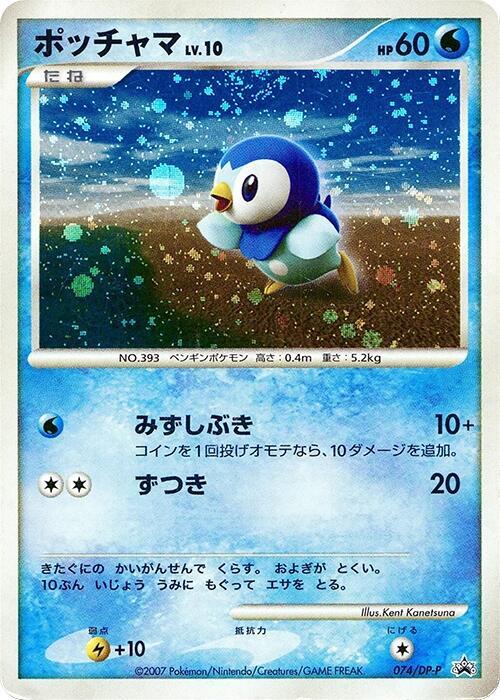
On Piplup 074/DP-P, 074 is the number within the promo series and DP-P identifies that series. There is no numeric set count after the slash.
The separate 393 beneath the illustration is Piplup’s species number. Use the complete promo code near the bottom right to find this card.
Try searching: Piplup 074/DP-P
Promo formats vary by era and language. For more Japanese examples, including ADV-P and XY-P, use our Japanese card identification guide.
3. Narrow down a Pokémon card number lookup
- Start with the name and full number. Enter one of the example searches above in KnowMyCards’ card search, or substitute the details from your card.
- Check the language and set. Even “Pikachu 025/165” returns English and Japanese entries, plus separately listed stamped or special-finish versions. Open a likely result and compare the printed text and artwork.
- Use the set when the results remain ambiguous. If you recognize the expansion, open it from the set directory and find the card there. A shared denominator alone does not establish the set.
- If nothing matches, check your transcription. Restore any omitted zeros, letters, slash or hyphen. If the full identifier still fails, search the name and browse the results; catalog text and coverage can be incomplete.
If the number is missing or unreadable, begin with the name, illustration and any visible set symbol or promo stamp. Some cards do not use these number formats. A failed search alone does not establish that a card is fake.
4. Confirm your copy before checking its price
Before treating a result as your card, compare the language, complete collector number, set, artwork, name designation and stamps. Include details such as “ex” or “V” when comparing names.
Then check the foil treatment and condition. A regular and reverse-holo printing can share a collector number, and a flat catalog image may not show the finish clearly. The number does not describe wear or establish a professional grade.
Once the identity matches, select the appropriate printing and condition on the card page. Check the source dates and use the pricing methodology guide to understand the estimates and reported sales. Current prices belong on those card pages, where you can inspect the specific version.